Ferfar (Land Mutation) Explained: What is it and How to Correct Errors?
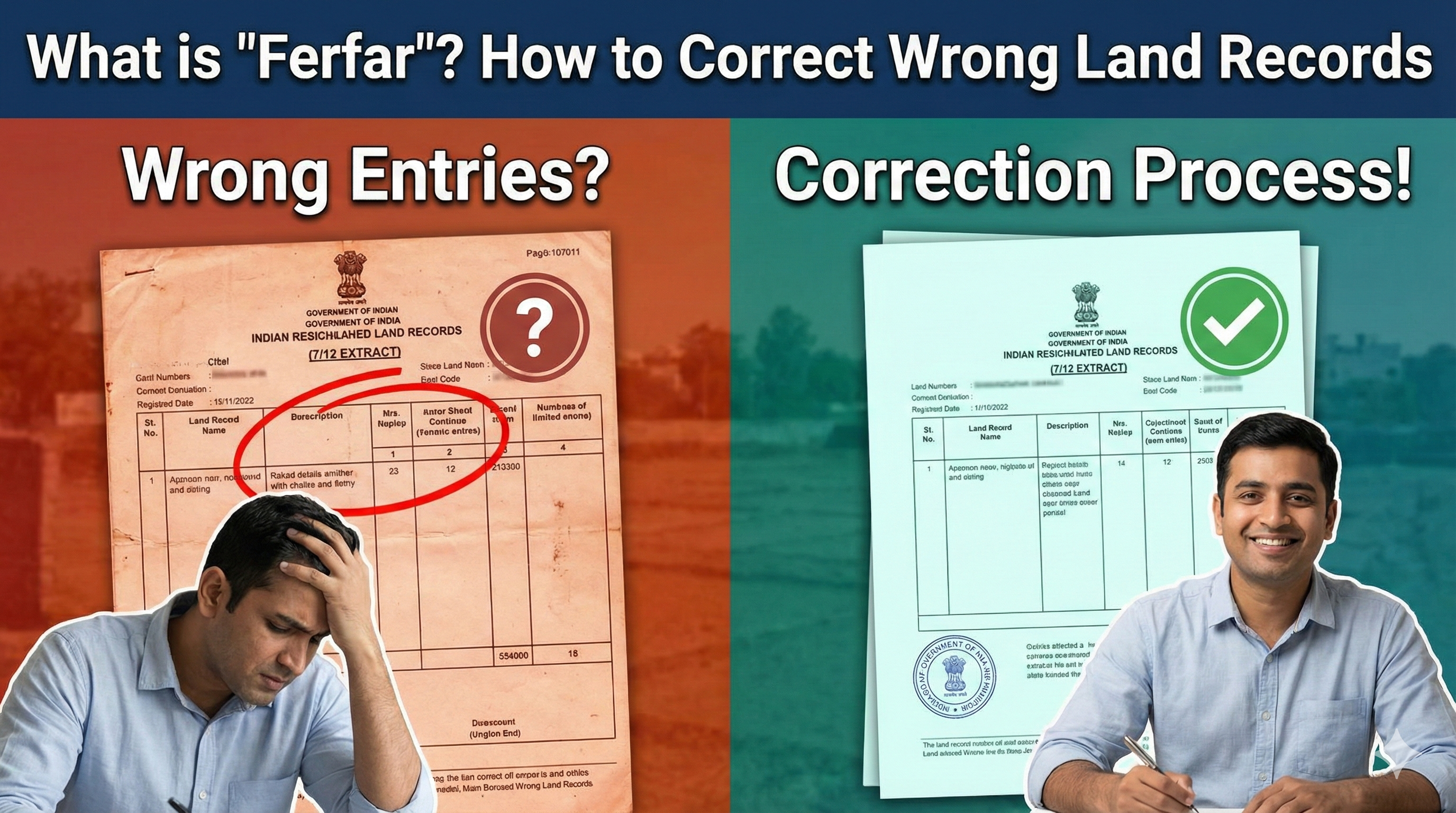
Posted on: 26 December 2025 | Category: Land Records / Blog
Whether it is agricultural land or non-agricultural land, every piece of land is recorded in government records. This is a long-standing government rule. Accordingly, information about the person who owns the land and details about the land itself are recorded. These land-related records are extremely important because Ferfar (Mutation) proofs are accepted in court to prove land rights. Disputes often arise in rural areas regarding this. Let's learn more about Ferfar entries and how to correct incorrect entries if they occur.
What is Ferfar (Mutation Entry)?
Every village government office maintains a register to record land-related transactions. Ferfar refers to the entries made in Village Form No. 6 (from forms 1 to 21). This is the Record of Rights and Mutation Register. It contains all information regarding land changes, transactions, sales and purchases, inheritance dates, and purchase amounts. This register is called the Ferfar Register. The entries from this register are then reflected on the 7/12 Extract (Satbara). Before making any entry on the 7/12 extract, it is mandatory to record it in the Ferfar register first.
Entries on the 7/12 Extract
Before any entry appears on the 7/12 extract, the matter must be recorded in the Mutation Register. This is also known as Village Form No. 6 or Village Form 'D'.
Types of Village Form No. 6 (Ferfar Types)
- Village Form No. 6A – Register of Disputed Cases.
- Village Form No. 6B – Register of Late Fees.
- Village Form No. 6C – Register of Inheritance Cases (Heirship).
- Village Form No. 6D – Register of Pot-Hissa (Sub-divisions).
Correction of Errors in Ferfar Entries
Incorrect entries made in the Ferfar register are often carried forward to the 7/12 extract. Therefore, it is essential to ensure correct entries are made in the Ferfar register right from the beginning. However, if mistakes happen, there is a specific process to correct them.
Often, mistakes occur in names, group numbers (Gut No.) might be omitted, or a relationship might be recorded incorrectly. In such cases (clerical errors), there is no need for a fresh entry by the revenue department. To correct a clerical error, the landholder should make an application directly to the relevant Tehsildar.
- The applicant has the right to get the relevant record corrected under Section 155 of the Maharashtra Land Revenue Code.
- In cases where the Revenue Department is at fault, the Tehsildar can take a decision and order the correction.
Correction of Errors Regarding Rights
If a person feels they have not been given their due place regarding ownership rights, tenancy, inheritance, or succession, they have the right to present their case based on appropriate evidence. For this, the most important step is to file an appeal or an application for revision in court against the Ferfar entry.
Correction of Errors Regarding Land Transactions
If there are errors in previous entries regarding land transactions (e.g., duplicate registration), an appeal must be filed. After such an application, the land is re-inspected, and only then is a decision regarding correction taken. Farmers/Land owners can file a complaint with the Tehsildar's office to insist on the correction of Ferfar entries.
How Ferfar is Recorded
Before recording any information on the 7/12 extract, entries are first made in the Ferfar book. In village records, this is called Village Form No. 6 – The Register of Mutations. The Mutation Register is considered the actual diary of changes. As names of owners or buyers change, these changes are recorded in the Ferfar register. It is crucial that these changes are correct; otherwise, the same wrong changes appear on the 7/12 extract, leading to legal difficulties.
Important Laws for Land Registration
- Registration Act: Section 17
- Maharashtra Land Revenue Code 1966: Section 149 & 150
- Transfer of Property Act 1882
Disclaimer: Please consult with official revenue department authorities or legal experts for specific land dispute resolutions.